
Before You Plan Curcuma: Liners, Bulbs & Temperature
3/26/2026
Before You Plan Curcuma: The Two Decisions That Make the Crop Uniform, On-Time, and Retail-Ready
A grower guide to starter material (liners vs. bulbs/rhizomes) and temperature stability.
In our first article, we shared why breeding and our KP Holland partnership matter. This next step is just as important: what happens once that genetic material enters your greenhouse.
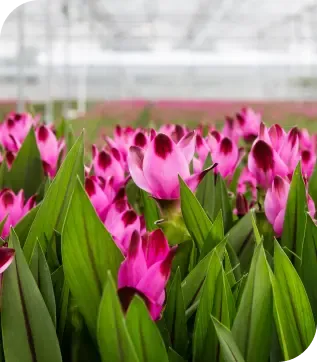
With Curcuma (Siam Tulip grown from our TC in cell packs), premium results are rarely accidental. The difference between a repeatable, high-quality program and an inconsistent crop usually comes down to two decisions: how you start the crop and how well you control the environment, especially temperature stability.
A quick note on genetics and starting material
Not all Curcuma programs are comparable. Differences in genetics and especially in starting material (liners vs. bulbs/rhizomes) can produce very different outcomes in uniformity, timing, and finished quality.
Foremost’s Curcuma program is built on KP Holland genetics are designed for a premium, repeatable finish—so comparisons with bulb-based programs in the market aren’t always apples-to-apples.
Starter material matters: liners vs. bulbs (rhizomes)
Starting with liners (starter plants)
When you start with a liner, you’re buying structure and consistency, not just potential.
Why liners typically perform better for premium programs:
- Higher Better uniformity: crops move grow more evenly, protecting your target ship window
- More predictable progression: fewer surprises early in the crop cycle
- More consistent finish: size, vigor, and stage are easier to align
- Easier to repeat year after year: ideal for a true program—not a one-time run
In short: liners support program-level execution.
Starting with bulbs/rhizomes
Bulbs (rhizomes) can work, but they often introduce more variability, especially early.
Common challenges with bulb-based starts:
- Less uniform sprouting (plants don’t “wake up” evenly)
- More variation in vigor and timing
- Greater sensitivity to early environment (temperature swings show up later)
- Less consistent finished product—and inconsistency shows at retail
In short: bulb-based programs can deliver Curcuma, but they typically require tighter early control and may produce more variation than liner-based programs.
Curcuma temperature requirements: why stability matters
Curcuma responds best to a warm, stable environment, especially during the start. When temperatures run too low or fluctuate too much, you’ll often see slower progress, uneven development, and timing delays that affect premium finish.
Optimum temperature targets (simple and usable)
- Early establishment / start: aim for 75–80°F daytime and 70–75°F nighttime
- After establishment: maintaining around 70–75°F with good stability supports steady growth
- Avoid extended dips below ~68°F, especially early, which can reduce momentum and uniformity
The key isn’t one perfect number—it’s avoiding stress from temperature swings. Curcuma rewards consistency.
Regional reality: same plant needs, different operating conditions
Curcuma’s needs don’t change—but the effort required to deliver them can vary by region.
- Cooler-climate production regions (e.g., Upper Midwest, Northeast, Pacific Northwest): the challenge is maintaining warm, stable temperatures early, especially at night, and humidity above 50%. Consistency at the start protects uniformity and timing.
- Warm-climate production regions (e.g., Florida and the broader Southeast, Southern California): warmth is typically easier to achieve, but success depends on managing temperature extremes and humidity, along with related pest pressure. Stability and control still drive premium finish.
Bottom line: same crop requirements—different greenhouse control strategies depending on local conditions.
FAQ
Is Curcuma a bulb or a rhizome?
Curcuma is commonly sold as a rhizome (often casually called a “bulb”). Production programs may start from rhizomes or from liners, with different results in uniformity and timing.
What temperature does Curcuma need?
A warm, stable start is key. Many programs target optimum temperatures of roughly 75–80°F days / 70–75°F nights early, then maintain around 70–75°F with stability.
Why do liners often finish more uniformly than bulbs?
Liners tend to reduce early variability and support more predictable progression, which protects timing and an even, premium finish.
Planning reminder
Next year Curcuma numbers need to be finalized by May. The fastest way to get aligned is a short conversation with your team.
Contact a Foremost Sales Rep: https://www.foremostco.com/our-roots/our-team
Other related Content: https://www.foremostco.com/blogs/ornamental-curcuma-siam-tulip-genetics-production