7/30/2026
Aglaonema Hybrids: How Foremost and Butler’s Foliage Are Growing Smarter Together
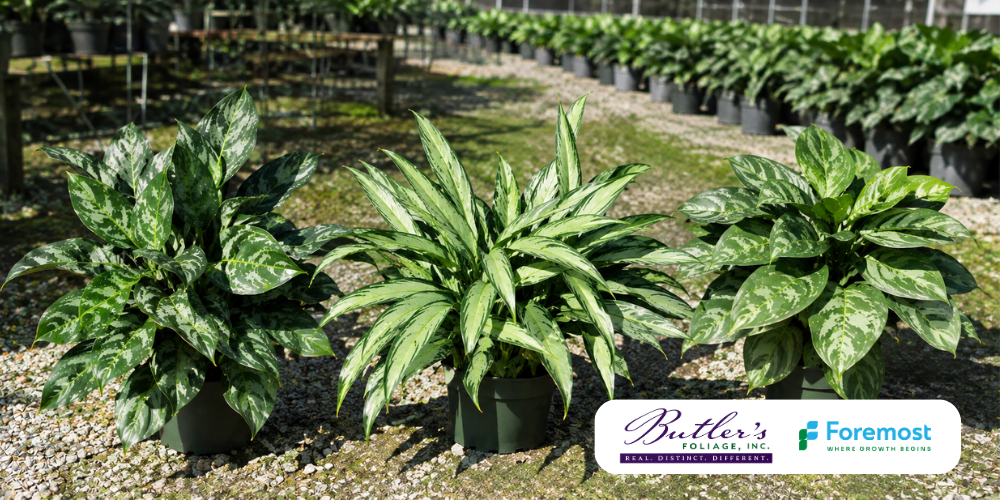
Through a long-standing partnership with Foremost, Butler’s Foliage has reduced Aglaonema production time by three to four months using rooted cuttings produced in Costa Rica. As modern hybrids gain renewed attention, the Florida grower sees growing opportunities for commercial foliage producers.
Nearly 25 to 30 years ago, Aglaonemas were flying off the shelves for foliage growers across the country. But as new plant varieties flooded the interior landscape market over the decades, the classic crop was gradually squeezed out.
Today, George Butler, president and owner of Butler’s Foliage, is seeing that trend reverse. Through a strategic partnership established with Foremost around 2010, the 50-acre Florida nursery has helped revitalize the plant category with robust new hybrids that slash production time and deliver dependable, long-lasting performance for modern indoor environments.
Improving Aglaonema Production Through Strategic Partnerships
Butler, whose family nursery began operations in 1961, first turned to Foremost roughly 15 years ago during the economic downturn following the 2008 real estate crash. Seeking to diversify his catalog, he worked with the supplier to offshore propagation and rooting for his proprietary Stars of India collection, a specialized line of hybrid Aglaonemas.
“I used to do all my propagation in-house,” Butler said. George Butler, President and Owner, Butler’s Foliage
“We discussed the possibility of them having stock plants of the Stars of India collection, which was a group of hybrid Aglaonemas I’ve been working with for quite a while. An alternative to doing my own propagation was having them do it and possibly root them for me, which they did, and it’s cut my production time by about three to four months.” Butler said.
By receiving rooted cuttings on a scheduled basis directly from Foremost’s facilities in Costa Rica, Butler eliminated the overhead, land, and labor required to maintain large, aging stock fields in south Florida.
“I no longer have to maintain stock plants or a stock field,” Butler said. “They have the stock field, they’re doing the rooting for me, and they come in on a schedule basis. So that frees up my labor that had otherwise been spent on maintaining stock or taking stock cuttings.”
Why Modern Aglaonema Hybrids Are Gaining Market Momentum
Beyond nursery efficiency, the program addresses key technical challenges that historically limited the crop. Older, traditional varieties such as Silver Queen required temperatures above 55 degrees Fahrenheit, creating high winter heating costs, while older Maria stock fields suffered from slow growth rates and disease pressures.
In contrast, modern hybrids offer improved cold tolerance, reduced crop time, and distinctive foliage patterns that appeal directly to a shifting consumer demographic.
“Aglaonemas are one of the few plants that will perform very well indoors in low light,” Butler said. “Aglaonemas are another bulletproof plant you can put in the house or on the interior. A lot of the new buyers, I’ll call them millennial generation and younger, haven’t grown up with a lot of Aglaonemas in their environment, so it’s a new plant to them. Once they get them indoors, they’re going to see how well they perform.”
With strong consumer satisfaction driving repeat orders and commercial demand steadily building, Butler sees a clear runway for market expansion.
“From the trend that I see now with Ag sales picking up, I think it’s going to be a real strong year to 2027 and going forward,” Butler said. “There was a point in time when I could not keep up with the production, and I see that starting already again.”
Butler’s Foliage is one example of how the right partnership can create new opportunities for growers. Could Aglaonema be the next addition to your growing program? Reach out to our team to explore our Aglaonema varieties and discover how Foremost can support your production goals.